Projects
MotiSpectra

1 / 3
- Developed a real-time emotion analysis software using Next.js and Python to seamlessly integrate with virtual call platforms (Zoom, Google Meet, MS Teams).
- Implemented intuitive user interfaces with dynamic radar graphs and rolling averages for visualizing emotion and attentiveness data.
- Built and trained ML models from scratch using the FER-2013 dataset for emotion and attentiveness recognition.
- Fine-tuned the YuNet face detection model, ensuring an accuracy rate of 97%

- Developed a mobile app to address vision impairment using React Native, Tesseract OCR (optical character recognition), and Django that recognizes text in images and narrates it aloud using Expo's speech synthesis service
- Verified legibility of text and summarized text into keywords using custom-trained Cohere NLP models, implementing NLP text pre-processing strategies to increase model effectiveness.
- Applied the Cohere API to implement advanced features such as text language detection and summarization
- Built a personalized physical therapy platform using React, TypeScript, and FastAPI that provides real-time posture correction and hands-free feedback through text-to-speech technology
- Trained a custom deep neural network in TensorFlow from scratch in 24 hours to generate individualized exercise routines based on user data including weight, height, age, and fitness goals
- Integrated YOLO v11 object detection model in PyTorch for real-time pose estimation and movement analysis, ensuring proper form during exercises with immediate actionable feedback
- Leveraged Cohere API to generate clear, concise exercise descriptions and instructions for nearly 20 different exercises, creating a dynamic and engaging therapy experience
1 / 3
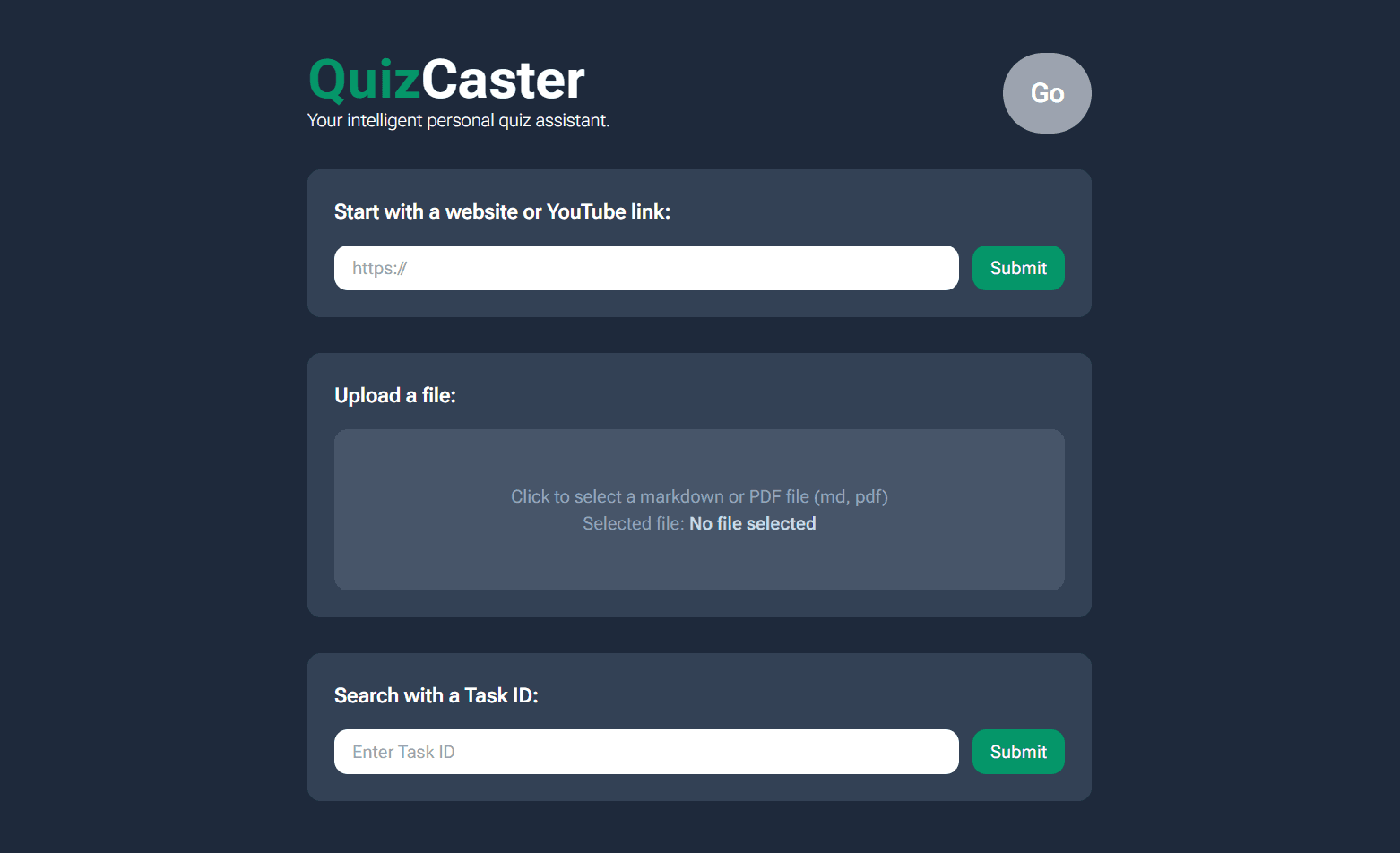
- Developed a web application with Python and OpenAI APIs to generate multiple-choice questions from a variety of content formats such as PDFs, websites, Markdown files, and YouTube videos
- Integrated text-to-speech and speech-to-text capabilities with Whisper AI and Microsoft Azure to provide greater accessibility to the visual impaired
- Trained a Naïve-Bayes machine learning model using 7.8 million lines of Wiki sentences to format text.
- Implemented caching by maintaining generated quiz questions in a MongoDB database, designating each with a unique UUID to allow for user replayability and sharing.

- Developed a personalized AI voice assistant that is powered by OpenAI APIs to provide long-term memory and context features, setting it apart from commercial voice assistants like Alexa or Siri
- Implemented voice recognition and transcription using Microsoft Azure and Whisper AI, and added GPT-4 and Hume AI's emotion detection model to allow the assistant to detect and adapt to the user's emotions, providing a more enhanced conversation experience.
- Integrated support for 10+ services features including Wolfram Alpha, Google Maps, News, and Spotify, allowing users to perform a wide range of tasks effortlessly
Review Recap
- Built a Chrome extension that parses and analyzes thousands of Amazon product reviews and sorts them by rating, allowing users to make purchasing decisions more easily and boosting efficiency
- Used CoHere's NLP and Beautiful Soup to scrape and extract keywords from 5000+ reviews in seconds
- Stored and cached results in a RESTful Django backend
GrubGuru
CS 346
1 / 3
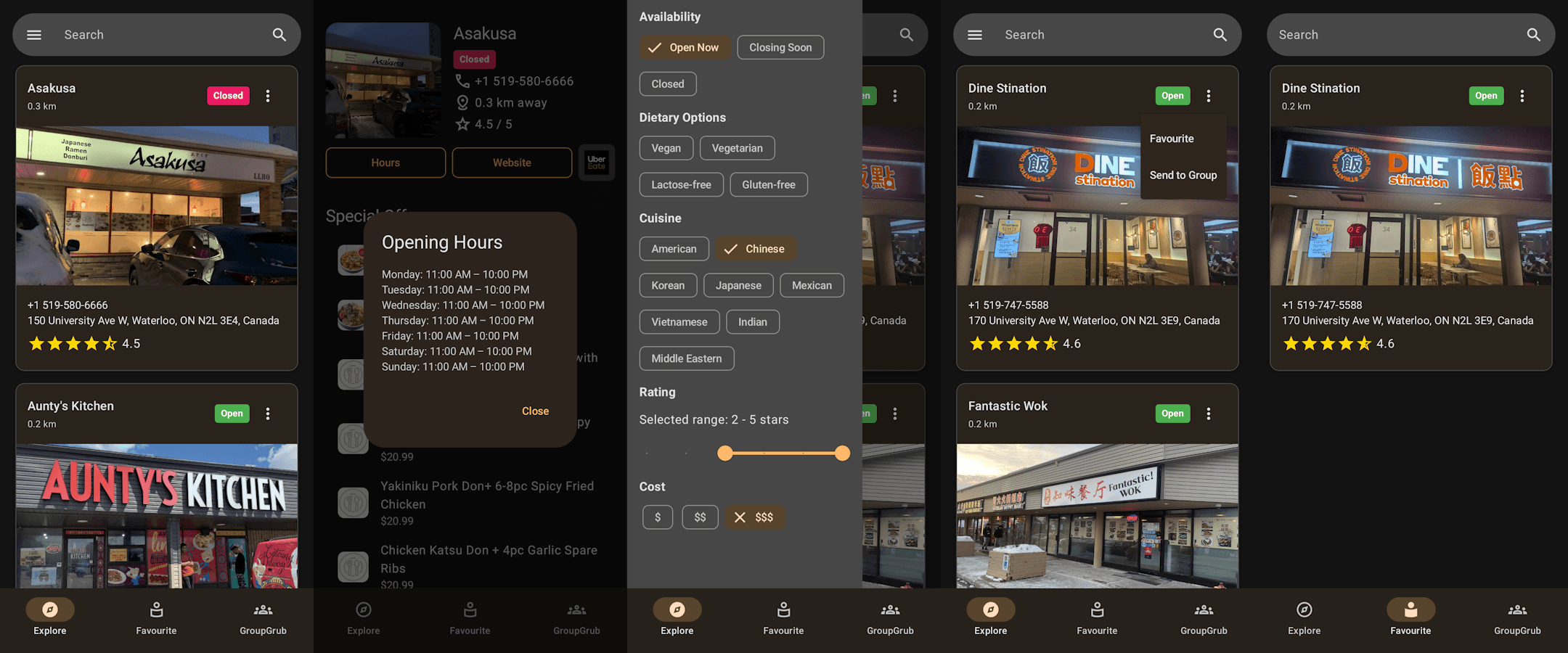
- Built a native Android app in Kotlin with Jetpack Compose for a Mobile Application Development course, helping groups of students decide where to eat by searching, favouriting, and voting on nearby restaurants
- Architected the app with MVVM and Kotlin Coroutines / StateFlow, with dedicated ViewModels driving reactive Compose UIs across the Explore, Favourites, and GroupGrub tabs
- Integrated the Google Places API and FusedLocationProviderClient to surface nearby restaurants filtered by availability (Open / Closed / Closing Soon), dietary restrictions, cuisine, rating, and price
- Implemented GroupGrub: users create or join a 6-character group code, shortlist restaurants together, then resolve indecision via a ranked 1–5 vote tallied on the server or a Randomize (re-roll) fallback
- Used Supabase (Auth, Postgrest, Storage, Realtime) as the backend so group membership, shortlists, and live votes sync across devices, and wrote JUnit / MockK unit and Espresso instrumentation tests for core flows
1 / 3
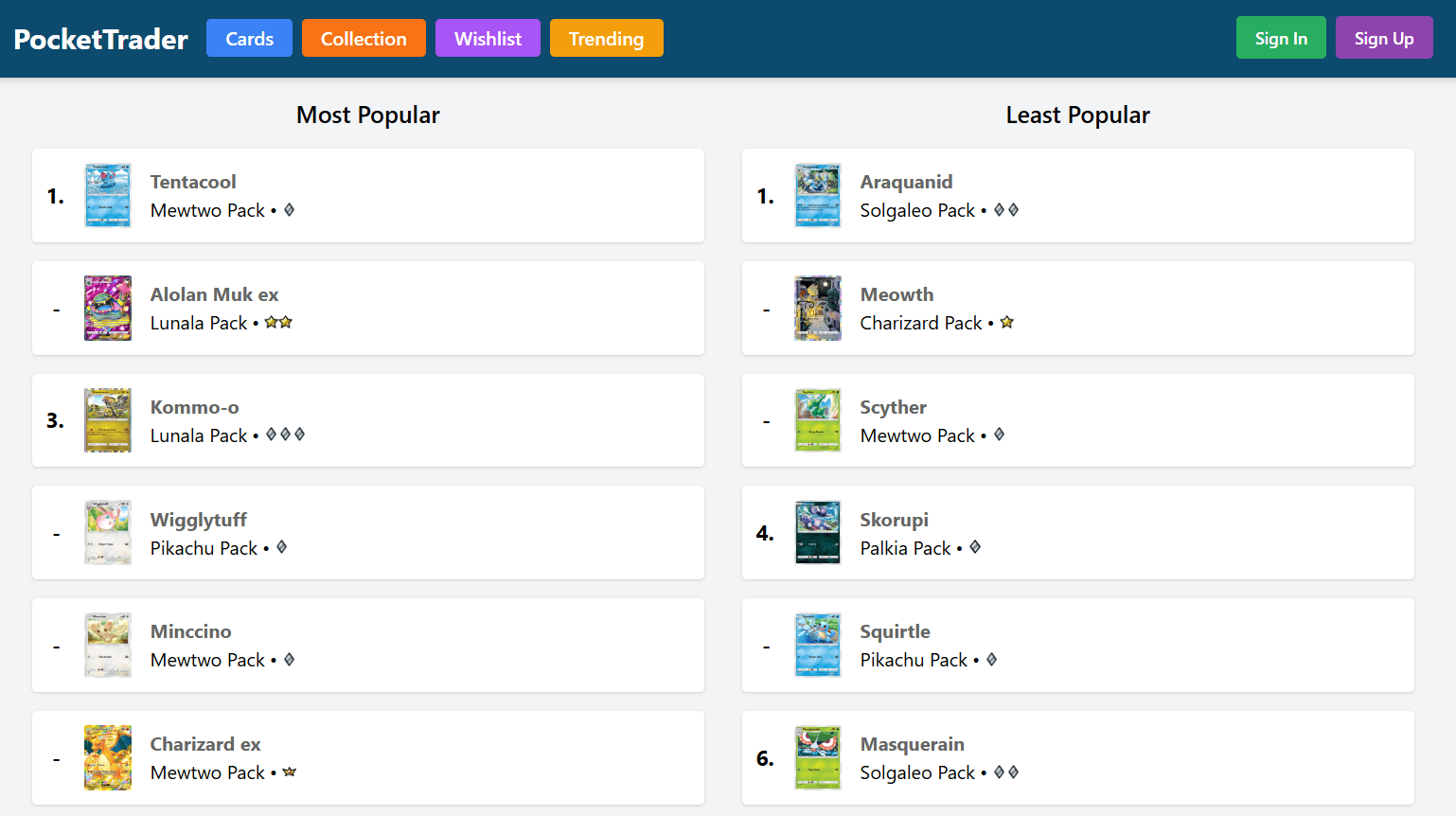
- Built a Pokémon TCG Pocket collection and trading platform for a Database Systems course, seeded with 732 cards fetched from the public TCGdex API across the first-expansion Mewtwo, Charizard, and Pikachu packs
- Designed a normalized MySQL schema (User, Card, Collection, Wishlist, Trade, TradeOpportunity) with an ER diagram and relational model, and implemented `INSERT ... ON DUPLICATE KEY UPDATE` upserts to keep per-user card quantities idempotent
- Tuned performance with targeted indexes (`idx_collection_card_qty_user`, `idx_wishlist_card_user`) and verified gains using `EXPLAIN ANALYZE` with `IGNORE INDEX` as the before-case — flipping the optimizer from full scans to index seeks on the production dataset
- Implemented a mutual-trade matcher: a 6-way join across Wishlist and Collection finds pairs of users where A wants what B spares and vice-versa, with a same-rarity constraint to keep trades fair
- Shipped a Flask (Python) REST API with every query stored as an auditable `.sql` file, PBKDF2-SHA256 password hashing via Werkzeug, a Next.js + Tailwind frontend for browsing/filtering/trading, and one-command local setup via Docker Compose
WLP4 Compiler
CS 241
- Developed a compiler for a language similar to C++ as part of a Compilers course
- Used CFGs and bottom-up parsing to define syntax and generate MIPS assembly code